(Looking for the old charts? They're here.)
A so-called random wire antenna is an end fed antenna. One end goes straight into the rig, often with no feedline, and the other end in the air attached to something as high as you can find, as described on the ARRL random wire page. The Wikipedia Electrical Length page has this very nice animation of a center fed dipole.

Notice how voltage (red) is always low at the center, a great attraction of center fed dipoles, but when the received signal is strongest the voltage at the ends is at its highest. Additionally, matching a large capacitive or inductive impedance can generate high voltage in the matching network. Unless the matching network is made of high voltage components impedance cannot be matched. When hardware can't be changed, the end fed solution is to move away from the high voltage. In other words, choose (cut wire) to receive a weaker signal so that the antenna tuner can successfully match. It is important to use a counterpoise with an end fed. A standard recommendation for the 40m band (see QST, March 1936, p. 32, "An Unorthodox Antenna") is an 84' long end fed and a 17' long counterpoise (6.5' for 20m). While these lengths have been shown to work well on many bands, which is helpful if you're in a hurry to get on the air, read up on the topic and experiment.
Other solutions are a more capable tuner or a better matched antenna. See AA5TB's excellent page for EFHW info. Short of that, cut the wire so that it is not a halfwave multiple of any frequency you want to use and accept a weaker signal so that you can impedance match.
For a given ham band its lower and upper band edge frequencies are converted by the famous 468/f to dipole lengths. QST, Oct 1926, "The Length of the Hertz Antenna" shows in line 2 of the table that a similarly installed random wire should use 423/f. W3EDP's results in the above referenced 1936 article, however, fall in line with 468/f and is used here. Change the program to use 423 if desired.
While these are the best lengths for center fed dipoles, they are typically the hardest to match lengths for end feds and the lengths should be avoided.
I wrote a program to do the light number crunching considering all band edges of interest. Again, optimal lengths for strongest signal are also the hardest, or worst, lengths for end-fed impedance matching. For multiple bands, harmonics are also considered. In addition, the wire should be at least 1/4 wavelength of the lowest desired frequency. The program simply calculates length from the venerable L=468/f for band edges and their multiples, for all bands specified.
The graph ranges from 1/4 to 1/2 wavelength by default since you must use at 1/4 of longest wavelength and there is no need for more than 1/2 wavelength of wire. An option is shown to graph a full wavelength, however. You can move your mouse over the graph and the length is displayed as 'x=###' in the upper right.
Download endfed.py and run as shown below. (The anaconda python distribution is an easy way to put python and many libraries on your machine.)
Modify bands in endfed.py for your country or favorite modes. Use it by putting space separated band names and a graph will be created. Sample runs are shown:
endfed.py 40 20 15 10
(half wavelength, feet).

endfed.py -f 40 20 15 10
(full wavelength, feet).

Other possible ways to run:
| endfed.py -m 40 20 15 10 | (metric). |
| endfed.py -c -m 40 20 15 10 | (CW sub-bands, metric). |
The 468/f rule of thumb was arrived at experimentally, but we now have electromagnetics-aware tools to make better predictions. Suppose we want an end-fed to use on ham bands from 40-10m. Using the python port of NEC-81 and a small program to generate input decks and then do multiple NEC runs, we end up with following VSWR predictions for wire length vs. vswr. A 17' counterpoise is used.
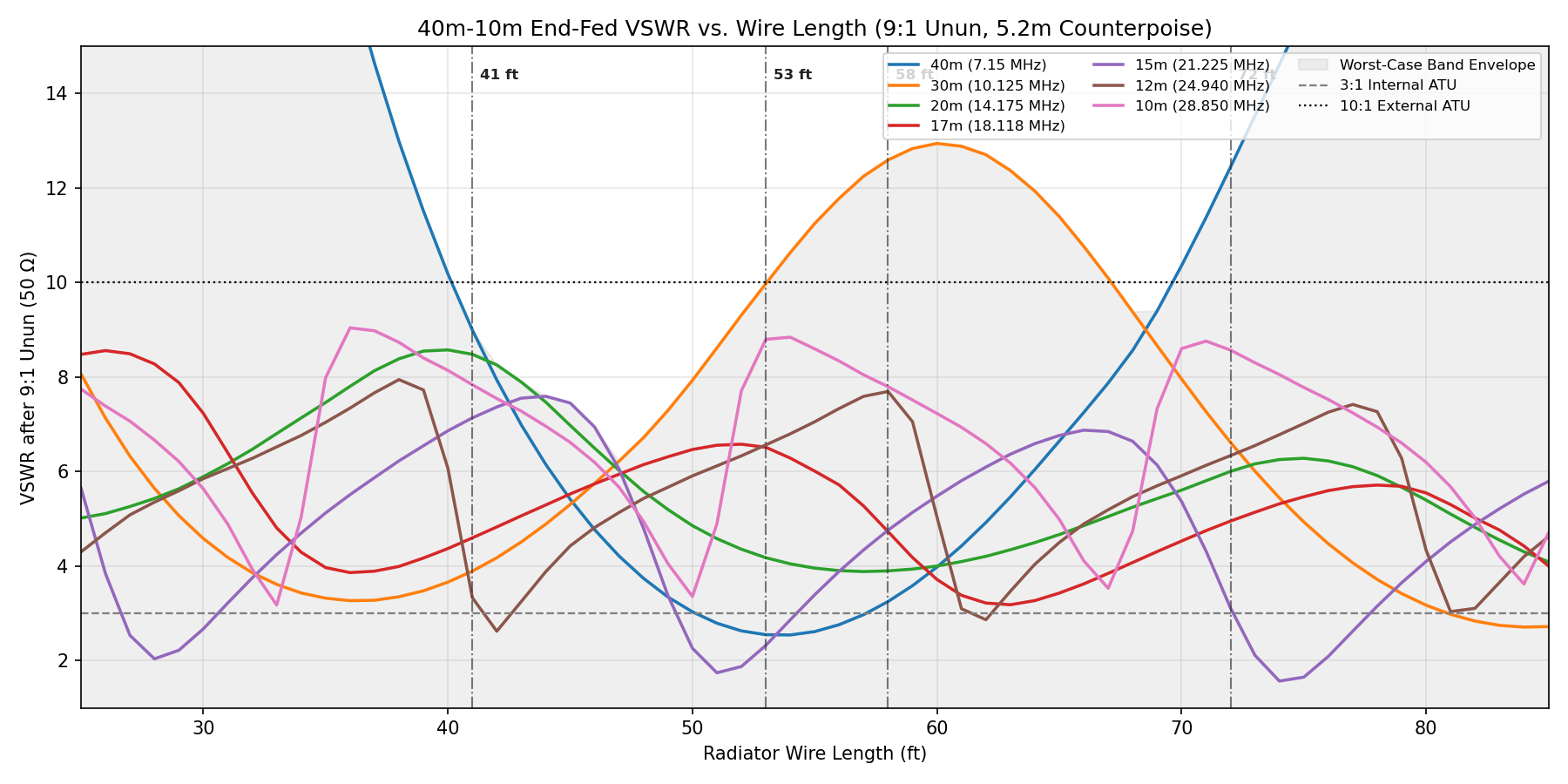
The program further sorts results picking best lengths ranking by most bands that can be matched by a 10:1 tuner, then ranked by 3:1 tuning and finally by average VSWR across all bands. Theoretically, 51' is the length you want. Of course, if counterpoise or wire are slightly different lengths, results differ, adjustment needed, all the usual antenna making experiences.
Best Wire Lengths (9:1 Unun, 5.2m CP):
Len   <=3:1  <=10:1  Avg   | 40m   30m   20m   17m   15m  12m   10m
------------------------------------------------------------------------
51    2/7    7/7     5.0   | 2.8   8.6   4.6   6.6   1.7   6.1  4.9
52    2/7    7/7     5.5   | 2.6   9.3   4.4   6.6   1.9   6.3  7.7
53    2/7    7/7     5.8   | 2.5   10.0  4.2   6.5   2.3   6.6  8.8
50    1/7    7/7     4.8   | 3.0   7.9   4.9   6.5   2.3   5.9  3.4
42    1/7    7/7     6.1   | 7.9   4.2   8.3   4.8   7.4   2.6  7.5
49    0/7    7/7     5.0   | 3.3   7.3   5.2   6.3   3.4   5.7  4.1
48    0/7    7/7     5.3   | 3.7   6.7   5.6   6.1   4.8   5.4  4.9
47    0/7    7/7     5.6   | 4.2   6.2   6.0   5.9   6.1   5.1  5.7
46    0/7    7/7     5.8   | 4.8   5.7   6.5   5.7   6.9   4.8  6.2
45    0/7    7/7     6.0   | 5.4   5.3   7.0   5.5   7.5   4.4  6.6
44    0/7    7/7     6.0   | 6.2   4.9   7.5   5.3   7.6   3.9  7.0
43    0/7    7/7     6.1   | 7.0   4.5   7.9   5.1   7.6   3.2  7.3
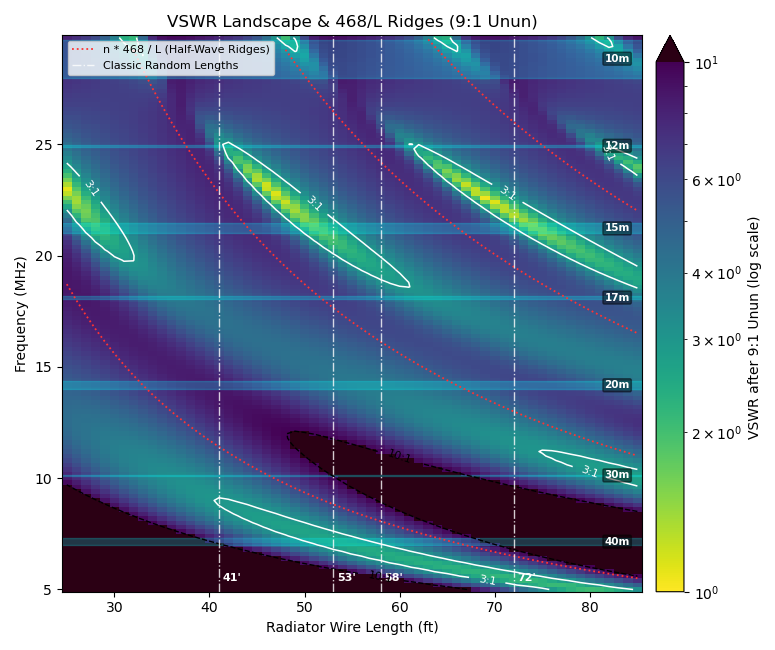
The data can be presented another way, too, the power of computing! This VSWR landscape shows ham bands shaded as light blue horizontal stripes. You want a vertical line (wire length) cutting through hambands intersecting as low VSWR as possible.
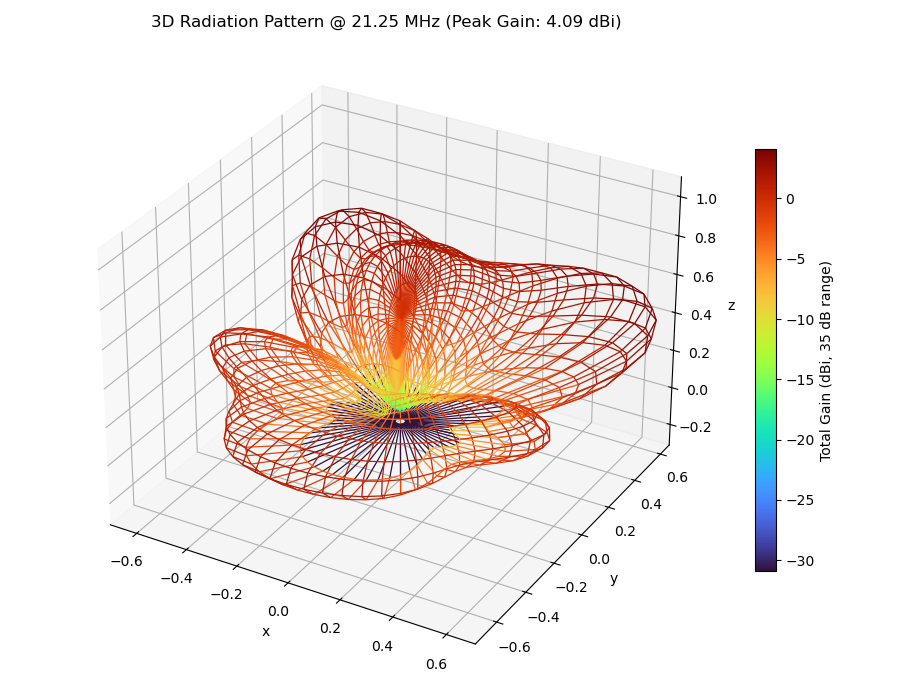
And here is the predicted pattern on 15m. When 468/f was new, hams would have given a lot to have this capability.